
[ad_1]
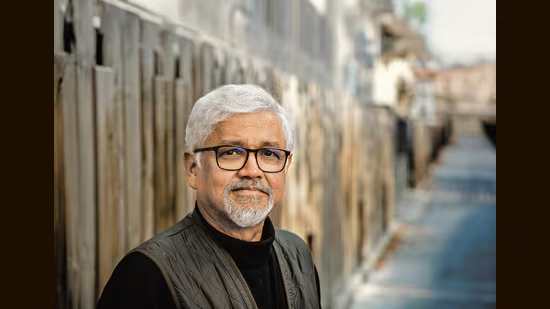
The past isn’t ever behind us, in Amitav Ghosh’s version of the world.

For him, these realms in which fact and make-believe are braided together form ever-present parallel dimensions of a kind, since no two versions are ever quite the same.
Ghosh’s new book, Ghost-Eye, due for release on December 15, works to extend the idea of what constitutes our past, invoking concepts of reincarnation and past life.
At the heart of this narrative is Varsha, a three-year-old girl from a family of vegetarian Marwaris in Kolkata, who suddenly refuses to eat anything but fish, and begins to recall details of a previous life in the Sundarbans.
Eventually, the book circles back to the theme that occupies Ghosh most: the climate crisis. If we are willing to buy into techno-utopian fantasies, might we not also consider other kinds of fantastical possibilities? Particularly if they could help us connect with each other, and reconnect with our planet?
“This has been an unusual book to write,” Ghosh says. “Usually, it takes me a long time, three years, sometimes four, to write a novel. This one wrote itself, in about a year. It felt the idea just came to me, from somewhere else, and I started writing.”
Excerpts from an interview.

* Why did you decide to place the theme of past lives at the heart of Ghost-Eye?
Reincarnation is something many of us in India take for granted and never think about. I have a friend who has had very vivid past-life memories. He remembered being born to a family in Mumbai, and one day, when he was barely four, he pointed out the house where he had lived in his past life. And yet this phenomenon poses such a powerful challenge to our sense of how the world works that, really, we try not to think about it.
Where, how does this happen? I have no explanation.
Do I believe it happens? Yes. The evidence suggesting it is absolutely overwhelming.
.
* The death of a loved one can often challenge pre-existing notions of life and what comes next. Was there such a loss in your life that led you to approach this book as you did?
Very much so. I lost my mother during the pandemic (in August 2020). She didn’t die of Covid; she had long-term COPD (chronic obstructive pulmonary disease). I was here in New York, she was in Kolkata, and I couldn’t go to her because of the lockdowns.
Before that, when I was with her in January that year, she had to be hospitalised. While in hospital, she had what is now described as a near-death experience. That event unlocked all kinds of thoughts about the world and so on. Yes, that certainly had a crucial role in the writing of this book.
.
* The protagonist of Ghost-Eye, Dinanath Datta, struggles to balance his scientific outlook with ideas that even Western science is now re-examining, such as near-death experiences. He is embarrassed, for instance, by a photograph of a levitating Indian yogi displayed at his alma mater, an American university…
Well, I have a PhD. Which means I was educated to be a rationalist, where all that exists is what you can see and touch… as if nothing exists beyond that. That’s still, in a sense, how half my mind works. Yet there’s this other half that’s of a completely different sort. It sees different things. There’s a constant dialogue between the two. I think this is the dialogue that exists for all of us in the modern world. One can’t just walk away from it.
One of the things I love about science is its rhetoric. All these binomial names, the linear classifications. But does all that really give us a better handle on our world than, say, the knowledge that a fisherman or a hunter or a herbalist has?
Historically speaking, the two worlds have been closely connected. Botanists learned from traditional herbalists. The great Hortus Malabaricus (a 17th-century Latin botanical treatise by the colonial administrator Hendrik van Rheede) pays tribute in its preface to an Ezhava herbalist (from Kerala). I think that’s a fascinating connection.
.
* In some ways, this is also a book about food…
You’re right; this is in many ways a book about food. I have always loved to cook and feed people so the book certainly reflects that aspect of my life. But it is also important to note that the primary way humans relate to their environment is through food. This is something that highly educated people tend to forget, because they relate to the world in very abstract ways, and that is becoming ever more so.
Many young people today have no idea where their food comes from or what goes into it. They seem to think it grows in the supermarket. People who think in that way will be incredibly vulnerable in the event of a supply-chain collapse, which is a very likely possibility.
* The book circles around to the idea of preventing such a collapse, using a kind of almost-magic, presented as an alternative to the world’s techno-utopian dreams. What is the magic you believe would turn this around? Or is Ghost-Eye essentially a reminder that whatever else happens, the wheel keeps turning?
I do believe the wheel will keep turning and that even if the world as we know it disintegrates; it will find some renewal.
It is now clear that many of the ideas touted by global elites are as fantastical as magic. In my book The Great Derangement (2016; non-fiction), I compared technocratic approaches to climate change with Pope Francis’s vision of the same issues (he has suggested that it is because of the “technocratic paradigm” that we “fail to see the deepest routes of our present failures” and the role that technology itself plays in them). In writing that part of the book, it became clear to me that Pope Francis’s vision was much more realistic than that of the technocrats, who seem to invest all their faith in magical, non-existent technologies.
I think, ultimately, we need to decentre our sense of human supremacy and anthropocentrism… I hope this book gives us a sense of humility in relation to the world around us, because this world is really a much stranger place than we imagine it to be.
.
* In your blog, you write that scenes and places from your books have turned out to have strange real-life resonance…
I have had incredibly uncanny experiences around writing. In The Calcutta Chromosome (1995), there is a very macabre scene that takes place at No. 3, Robinson Street. It’s a street I’d never seen before I wrote the book. I think, 15 or 20 years later, it turned out that something much more macabre than I had imagined happened in this place. There was a man who lived there with the decaying bodies of his relatives, for years.
I mean, how did I think of that address, that number?
Then again, it poses this extraordinary question: What does this say about time? Does time exist in simultaneities? I don’t have an answer.
.
THE STORY SO FAR: AMITAV GHOSH
* Ghosh, 69, is a Jnanpith awardee and author of the bestselling Ibis Trilogy, consisting of the historical works of fiction Sea of Poppies, River of Smoke and Flood of Fire. Last year, he was awarded the Erasmus Prize for his body of work on climate change. Born in Calcutta, he was raised across India, Bangladesh and Sri Lanka; studied in Delhi, at Oxford and in Alexandria; and now lives in New York, with his wife, writer Deborah Baker.
* What is his take on reincarnation? “This is something many of us in India take for granted. It poses such a powerful challenge to our sense of how the world works that, really, we try not to think about it,” he says. “Do I believe it happens? Yes. The evidence suggesting it is absolutely overwhelming. Where, how does this happen? I have no explanation.”
* How does he reconcile that with his scientific outlook, as someone with a PhD, steeped in research (about the climate crisis, among other things)? “There’s a constant dialogue between the two (ways my mind works). I think this is the dialogue that exists for all of us in the modern world,” he says. The truth, he adds, is that “it is now clear that many of the ideas touted by global elites are (also) as fantastical as magic.”
[ad_2]
Source link