

[ad_1]
The crisis at IndiGo that led to scores of flights being cancelled daily since early last week threw the country’s entire aviation ecosystem out of gear. The reason for that outsized impact is IndiGo’s sheer dominance of India’s aviation sector: the carrier accounted for six out of every 10 Indian passengers travelling by air on domestic sectors and it is, for all intended purposes, too big to fail.
The true extent of IndiGo’s stranglehold over India’s domestic aviation market goes well beyond its nearly 65 per cent domestic market share by passenger volumes and the mantle of the country’s largest airline. While India’s aviation sector is effectively a duopoly — with the Air India group having a market share of 26.5 per cent as of October — a bulk of IndiGo’s routes are monopoly routes, where only the blue tails of the airline fly. Although the Air India group is a distant second to IndiGo, the two have a combined domestic market share of over 90 per cent, making the airline sector the top sector in India in terms of market concentration.

In all, Indian airlines fly around 1,200 domestic routes, of which IndiGo has over 950 routes in operation. Notably though, nearly 600 — or 63 per cent — of these are monopoly routes, and about 200 (21 per cent) are duopoly routes where IndiGo has just one competitor, as per data analysed by aviation analyst and former network planner Ameya Joshi. Now, routes under the government’s regional connectivity scheme (RCS) are monopoly by design in most cases, but the leader there is government-owned regional carrier Alliance Air; IndiGo’s monopoly routes are not really linked to the RCS.
IndiGo’s monopoly on a significant number of routes and the duopoly in India’s airline sector is not by design, and much of it can be attributed to the failure of other domestic airlines to compete effectively, and even survive. Many have gone under over the past couple of decades — Go First and Jet Airways being the biggest examples over the past few years. To that extent, it can be argued that the presence of a dominant airline means that many routes, which would otherwise shut down, are in operation. And until this crisis broke, IndiGo had established benchmarks for operational efficiency and an unblemished safety record in India’s otherwise chequered aviation scene.
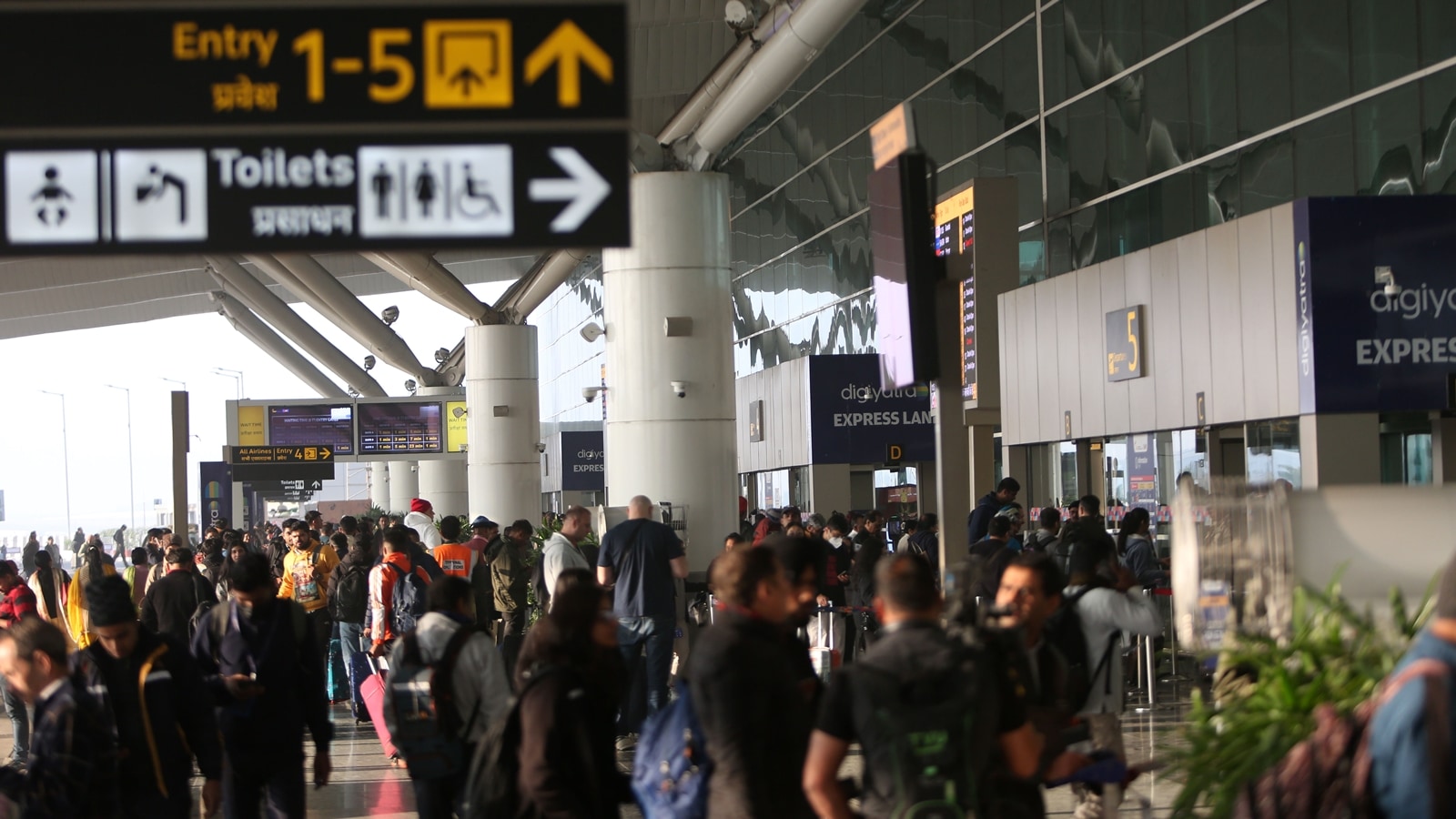 At the Delhi airport on Sunday. (Express photo by Gajendra Yadav)
While the airline is now limping back to stable and normal operations in a step-by-step manner, largely due to temporary exemptions that the sector regulator seemed forced to grant given the scale of the disruption, the past one week has underscored the risks of high market concentration in the sector. The import of the situation is not lost on the country’s civil aviation establishment. Speaking in Parliament on Monday, Civil Aviation Minister K Rammohan Naidu said that given the high growth in air travel demand in India, the country needs five big airlines.
Even beyond aviation, for India, where a growing number of sectors — like telecom, cement, steel, private ports, private sector airports, and specific segments within the larger e-commerce space — have seen an increase in market concentration over the past few years, the IndiGo crisis is a wake-up call on the perils of monopolies and duopolies.
Experts point out that while large, strong and stable companies are desirable in every sector for efficiency, stability and competitiveness, it gets problematic if their share of the market expands to such an extent that it smothers other players and creates a high entry barrier.
Story continues below this ad
“Monopolies may be bad at a country level, but they do wonders at route level in the case of aviation. Had it not been for IndiGo, so many routes would not have been operationalised in India, forcing passengers to take one-stop flights. IndiGo’s presence against multiple other (airline) failures has given the airline its monopoly status and is not by design. In such a monopoly and duopoly situation, there should be greater penalties in place so that such industries know the responsibility that comes along with a large duopoly,” Joshi said.
A senior government official said market dominance is not the real problem, it is abuse of dominance. And that some sectors are natural monopolies, given the nature of those sectors. That may ring true, but increasing concentration does end up deterring other potential competitors from entering the sector since they perceive policies to be favouring some players over others. And when this dominance is reinforced by the inorganic route such as acquisitions, concerns emanate over the inevitability of other businesses eventually being gobbled up by the dominant players, another senior government official handling a key infrastructure sector told The Indian Express.
Notwithstanding the reasons for this high market concentration, such a skewed market share ratio in any industry is concerning, according to experts and some senior government officials. Being a customer-facing industry, the impact is far more immediate and easy to spot in the airline sector than various other sectors in the business-to-business (B2B) domain. High market concentration problems include systemic risk if the dominant players falter, fewer choices for consumers due to low competition, higher prices, less innovation and lower quality.
The lessons are instructive for policy makers given that market concentration continues to increase in India’s key industries as top players have grabbed a larger share of the business, mostly through acquisitions, alongside organic growth. The Herfindahl-Hirschman Index (HHI), a measure of market concentration in an industry, has been increasing in sectors such as telecom, airlines, cement, steel and tyres.
Story continues below this ad
According to the Antitrust Division of the US Department of Justice, the HHI takes into account the relative size distribution of the firms in a market. The HHI increases both as the number of firms in the market decreases and as the disparity in size between those firms increases. Agencies generally consider markets in which the HHI is between 1,000 and 1,800 points to be moderately concentrated, and consider markets in which the HHI is in excess of 1,800 points to be highly concentrated. Sectors like aviation, telecom, steel and paints in India have HHI scores above the 1,800-point threshold, as per industry estimates.
According to a 2023 working paper on Industrial Concentration in India by Gaurav Ghosh of KREA University and Subhashish Gupta of Indian Institute of Management-Bangalore, while concentration of economic power is usually frowned upon because its social and political effects are substantial and undesirable, on the flip side one can argue that concentration provides the necessary scale to compete in international markets.
[ad_2]
Source link