

[ad_1]
As the 26th Reserve Bank of India Governor, Sanjay Malhotra stepped in when sentiment was sagging, growth stalling, and monetary policy having entered an extended phase of status quo. His first year has been defined by an aggressive 125-basis-point (bps) reduction in the repo rate after a long delay — the policy rate was at 6.5 per cent since February 2023 before it was cut by 25 bps in February 2025. Growth, inflation projections, and the stance of monetary policy have been changed very quickly in a clear departure from the more sedate alterations under previous central bank chiefs.
To be sure, every RBI governor invariably walks into a storm. However, the issues confronting Malhotra, who completed one year as the central bank governor on Thursday, are more worrisome going forward than those he tackled in his first year. He will not only face bigger tests, but will also have to weather challenges to the Indian economy and the RBI’s credibility.

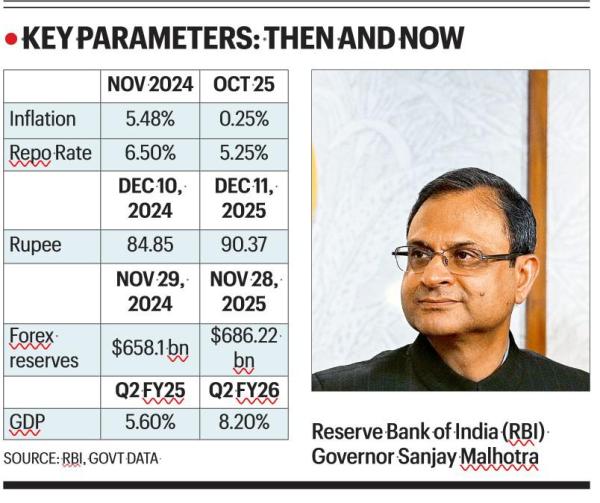
Malhotra took charge when the economy was already limping, with GDP growth at a seven-quarter low of 5.4 per cent in Q2 FY25 and inflation at 5.48 per cent in November 2024 — well above the RBI’s medium-term target of 4 per cent. The challenges on the horizon are even harsher as the rupee remains under siege, vulnerable to swift swings in global capital and financial markets. Foreign investors are fickle. Pulling money out at the first sign of weakness, they have already withdrawn Rs 1.58 lakh crore so far in 2025 from the equity market. The trade deficit is widening, exports have begun to fall, the rupee has breached the 90-mark against the US dollar, and India’s dependence on volatile global capital flows continues to test policy flexibility.
“The surge in H1 FY26 (April-September) headline growth on account of technical factors is set to fade next year. A competitive rupee will remain a priority,” said Radhika Rao, executive director and senior economist, DBS Bank.
Domestically, the RBI will be forced to conduct a delicate balancing act: keeping growth alive without letting inflation flare up again. A single supply shock, a spike in global oil prices, or another geopolitical conflict could quickly undo the carefully-delivered stability. The banking system, though healthier than before, continues to grapple with patchy credit demand, high corporate leverage in pockets, and liquidity conditions that can turn hostile overnight.
Things won’t be easy on the regulatory front either — long-pending reforms need to be pushed through without triggering a system-wide disruption. A financial sector still vulnerable to shocks requires constant vigilance. Payment systems, non-bank financial companies (NBFCs), fintech firms, digital lending platforms, and the world of cryptocurrencies and stablecoins can pose risks that the RBI cannot afford to underestimate.
On the inflation front, the RBI has revised its forecast for FY26 from from 4.2 per cent in February, to 4 per cent in April, 3.7 per cent in June, 3.1 per cent in August, 2.6 per cent in October, and to 2 per cent last week.
Story continues below this ad
The growth projection for FY26 has also been hiked in response to unexpectedly high outcomes, from 6.5 per cent in August to 6.8 per cent in October and 7.3 per cent earlier this month.
To be sure, economists have said in unison that the RBI is overestimating inflation. The central bank has remained cautious even as it trimmed its forecast every two months.
While Malhotra had promised to be agile when he took charge as the Governor in December 2024, improving the central bank’s forecasting models will probably take more time. The result is, in Malhotra’s own words, that India has entered a “rare Goldilocks period” of low inflation and strong growth.
Reigniting growth
In his very first monetary policy review in February 2025, the Malhotra-led Monetary Policy Committee (MPC) kicked off by delivering the first interest rate cut in nearly five years. Another 25 bps cut was delivered in April, followed by an unexpectedly large 50 bps reduction in June, and the year’s final rate cut on December 5 dragging the repo rate down to 5.25 per cent.
Story continues below this ad
While monetary policy actions impact growth with a lag, the interest rate reductions in conjunction with key government measures such as the personal income tax cut announced in the 2025-26 Budget and the Goods and Services Tax (GST) reforms of September have given an impetus to growth that should continue for some time even if the headline GDP growth numbers moderate from 8 per cent in the first half of FY26. The message is clear: Malhotra, aided by the government’s move to rationalise GST rates and boost festive demand, wanted to get the economy back on its feet.
“The domestic environment is congenial for further easing as CPI inflation is falling to unprecedented levels and the central bank expects it to remain low or manageable till the Q2 of the next year. At present, domestic consumption is strong and demand outlook is promising – rural demand is robust and urban demand is recovering,” said Umesh Mohanan, ED & CEO of Indel Money.
Cooling inflation
If revising growth was one part of the strategy, bringing down inflation was the other. From 5.48 per cent in November 2024, inflation has fallen to a record low of 0.25 per cent in October this year. Accompanied by plenty of good fortune in the form of favourable base effects and softening commodity prices, downward pressure on inflation has also been exerted by the GST rate cuts and co-ordination between New Delhi and Mumbai in keeping prices, especially those of food items, in check.
The result has been an unusually direct admission from Malhotra that the RBI finally had control over both sides of the equation. “The growth-inflation balance, especially the benign inflation outlook, provides the policy space to support growth momentum,” he said last week.
Story continues below this ad
With inflation expected to remain soft and even undershoot the 2 per cent projection for FY26, Malhotra enters his second year with the kind of freedom most governors only dream of. The worry now is about the potential reversal of the favourable base effect, the uncertainty around the Monsoon, and rising imported inflation due to the falling rupee.
There are two structural factors at play. First, the Consumer Price Index (CPI) inflation series will be overhauled in February. Not only will the inflation number have a new base year of 2024, but it will be based on an expanded basket of items that will see a reduction in the weight of food. Second, the flexible inflation targeting framework is currently under review and the RBI’s mandate for the five years starting FY27 is to be decided by March. Most experts favour retaining the target at 4 per cent in a band of 2-6 per cent.
Transmission issue
Cutting interest rates amounts to nothing if banks don’t pass them on. Within weeks of taking charge, Malhotra continued the work started by his predecessor Shaktikanta Das and rolled out aggressive measures to boost liquidity in the banking system — or the grease which runs the financial machinery.
Then came the big move: a 100 bps cut in banks’ Cash Reserve Ratio (CRR) in June, which would release about Rs 2.5 lakh crore in the second half of 2025. This was a clear message: banks must lend, and for cheaper.
Story continues below this ad
As per data available for the period before the MPC’s December repo rate cut, India’s banks had lowered interest rates on new loans by around 69 bps as against a 100 bps cut in the policy rate. Even loans made in the past have seen a noteworthy 63 bps fall in their interest rates.
Malhotra’s work continues. In a meeting with heads of banks earlier this week, Malhotra told the lenders that given the 125 bps of repo rate cuts and greater use of technology, efficiency should rise and the cost involved in the process of lending should be lower.
Delayed reforms
Instead of relying on consultation committees or endless reviews, Malhotra pushed through reforms that had been pending for two to three years. Reforms related to expected credit loss (ECL) norms, project finance rules, liquidity coverage ratio (LCR) norms, business forms, prudential investment regulations, all suddenly moved. Banks have even been allowed to finance corporate takeovers.
But some of these measures can boomerang if banks don’t tread cautiously. “If executed prudently, this could become the single biggest enabler of India’s next M&A cycle,” said Kunal Gala, partner (deal value creation), BDO India.
Story continues below this ad
The RBI introduced a flurry of banking reforms after consulting lenders. Feedback was taken and reforms delivered with minimum disruption.
A bold forex shift
The most striking difference between Malhotra and his predecessor, undoubtedly, is the exchange rate management strategy.
Unlike the heavy-handed intervention under Das, Malhotra has let the rupee find its level more freely than market participants had anticipated. Under Das, the RBI’s large and frequent interventions in the foreign exchange market attracted criticism for various reasons: dollar sales to keep the rupee stable drained forex reserves. The rupees bought in return soaked up liquidity from the domestic banking system, which could be replenished through other tools. Finally, keeping the rupee as stable as it was under Das distorted incentives — market participants should hedge their risks, but if the exchange rate is excessively stable thanks to the central bank, then there is no risk.
Malhotra changed the game instantly and the numbers clearly show it: after selling close to $400 billion of foreign currency in FY25, the RBI has sold just $44 billion in the first half of FY26. While this has led to the rupee breaching the 90-per-dollar mark, economists are in agreement that this depreciation is much-needed.
Story continues below this ad
On the whole, Malhotra has had a good ‘Year One’. But the real battle begins now as uncertainty over India’s trade deal with the US continues. The positive impact of frontloaded imports has faded and interest rate and tax cuts have been delivered. Now, the economy must continue to perform.
[ad_2]
Source link