

[ad_1]
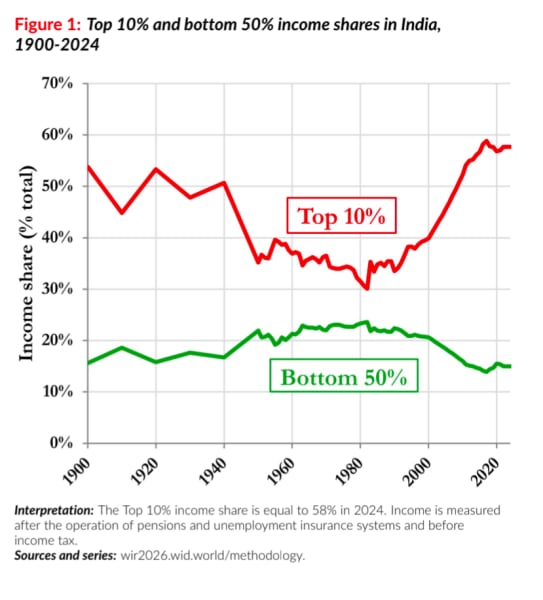
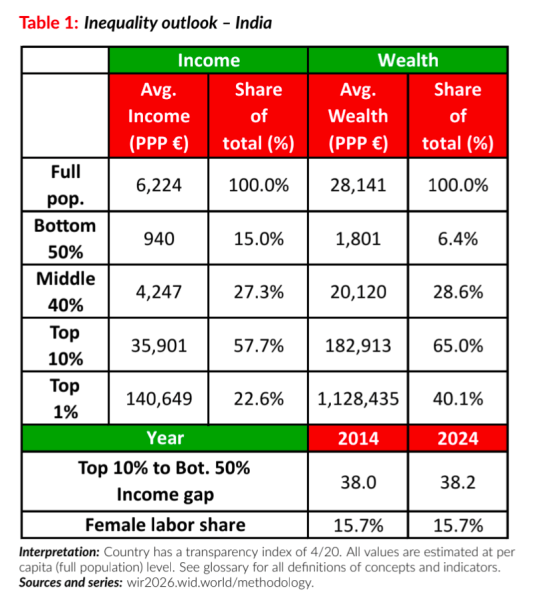
Income inequality in India remains among the highest the world, with top 10 per cent of earners capturing 58 per cent of national income, while bottom 50 per cent receiving only 15 per cent, the latest World Inequality Report 2026, edited by economists Lucas Chancel, Ricardo Gómez-Carrera, Rowaida Moshrif, and Thomas Piketty, stated. Wealth inequality is even greater in India, with the richest 10 per cent holding around 65 per cent of total wealth and the top 1 per cent holding about 40 per cent, the report released by the World Inequality Lab on Wednesday said.
“Average annual income per capita is around 6,200 euros (PPP), and average wealth stands at about 28,000 euros (PPP). Female labor participation remains very low at 15.7%, showing no improvement over the past decade. Overall, inequality in India remains deeply entrenched across income, wealth, and gender dimensions, highlighting persistent structural divides within the economy, the report, prefaced by economists Jayati Ghosh and Joseph Stiglitz, said.

Globally, wealth has reached historic highs but remains very unevenly distributed, with the top 0.001 per cent, comprising fewer than 60,000 multi-millionaires, owning three times more wealth than the entire bottom half of humanity combined. Their share has grown steadily from almost 4 per cent in 1995 to over 6 per cent today, and comes in the backdrop of the explosion of global inequalities and the weakening of multilateralism, the report said.
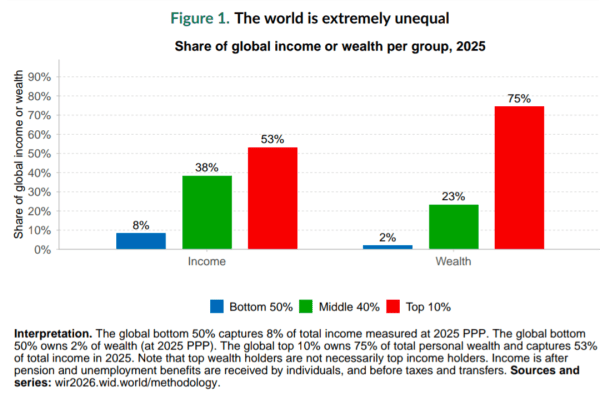
The global top 10 per cent owns three-quarters of all wealth, while the bottom 50 per cent holds just 2 per cent, the report said. “Zooming further in, the concentration becomes staggering. The top 1% alone, roughly the adult population of the United Kingdom, controls 37% of global wealth. This is more than eighteen times the wealth of the entire bottom half of the world population, a group as large as the combined adult populations of China, India, the United States, Indonesia, Nigeria, Brazil, and Russia,” it said.
The top one-in-a-million, collectively hold 3 per cent of global wealth, more than the bottom half of the world’s adult population.
Thomas Piketty, Co-Director of the World Inequality Lab, said: “The World Inequality Report 2026 comes at a challenging political time, but it is more essential than ever. Only by continuing the historic movement toward equality will we be able to address the social and climate challenges of the coming decades.”
Providing a geographic breakdown of global income groups in 1980 and 2025, the report said in 1980, the global elite was concentrated in North America & Oceania, Europe. Latin America also had some presence near the top, but China and India were almost entirely confined to the bottom half of the distribution. “At that time, China had virtually no presence among the global elite, while India, Asia in general, and Sub-Saharan Africa were heavily concentrated in the very lowest percentiles,” it said.
By 2025, China’s position has shifted
Story continues below this ad
upward with much of its population having moved into the middle 40 per cent, and a growing share having entered the upper-middle segments of the global distribution. India, the report said, has
lost relative ground: in 1980, a larger part of its population was in the middle 40 per cent, but today almost all are in the bottom 50 per cent. Sub-Saharan Africa has also remained in the lower half of the global distribution.
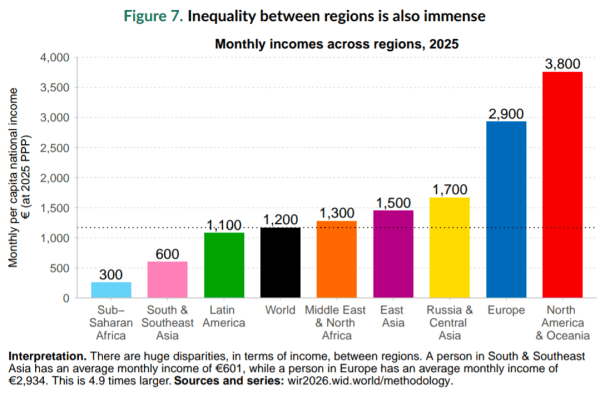
In gender terms, the pay gap persists across all regions, especially for unpaid labour. Excluding unpaid work, women earn only 61 per cent of what men earn per working hour; and when unpaid labor is included, this figure falls to just 32 per cent. “Globally, women capture just over a quarter of total labor income, a share that has barely shifted since 1990. When analyzed by regions, in the Middle East & North Africa, women’s share is only 16%; in South & Southeast Asia it is 20%; in Sub-Saharan Africa, 28%; and in East Asia, 34%. Europe, North America & Oceania, as well as Russia & Central Asia, perform better, but women still capture only about 40% of labor income,” it said.
The report also highlighted the climate crisis stating that the poorest half of the global population accounts for only 3 per cent of carbon emissions associated with private capital ownership, while the top 10 per cent account for 77 per cent of emissions. The wealthiest 1 per cent account for 41 per cent of private capital ownership emissions, almost double the amount of the entire bottom 90 per cent combined, the report stated.
Story continues below this ad
The World Inequality Report 2026, the third report in the series after earlier 2018 and 2022 editions, is based on the work of over 200 scholars across the world, affiliated with the World Inequality Lab.
The report said the averages present a starker picture of the inequality. For instance, a person in the bottom 50 per cent owns about 6,500 euros, while someone in the top 10 per cent holds around 1 million euros. But the average wealth of a member of the top 0.001 per cent (about 56,000 adults) is nearly 1 billion euros, and those in the top one-in-100 million (just 56 adults worldwide) hold on average 53 billion euros each. “To put this into perspective, the wealth of a single individual at that level can surpass the individual annual GDP of several Sub-Saharan African countries. These figures underline that today’s inequality is driven not only by the divide between the poor and the rich, but also by the widening gap within the top itself,” the report noted.
Noting that policy can reduce inequality, the report said taxation often fails where it is most needed: at the very top of the distribution with the ultra-rich escaping taxation. Effective income tax rates climb steadily for most of the population but fall sharply for billionaires and centi-millionaires, it said. “These
Elites pay proportionally less than most of the households that earn much lower incomes. This regressive pattern deprives states of resources for essential investments in education, healthcare, and climate action,” it said, adding that progressive taxation is crucial to mobilise revenues to finance public goods and reduce inequality, especially by ensuring that those with the greatest means contribute their fair share.
Story continues below this ad
Measures such as public investment and redistributive schemes can also help in reducing disparity. “Public investment in free, high-quality schools, universal healthcare, childcare, and nutrition programs can reduce early-life disparities and foster lifelong learning opportunities…another path is through redistributive programs. Cash transfers, pensions, unemployment benefits, and targeted support for vulnerable households can directly shift resources from the top to the bottom of the distribution,” it said.
[ad_2]
Source link